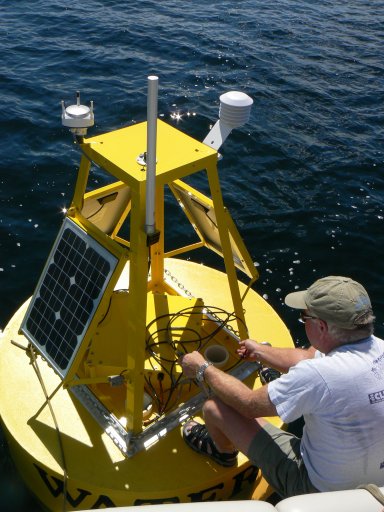
- The following is how we plan on testing to see if the research buoy will work.
- Meet with team at dock to board the Blue Sea research vessel.
- Once on the boat, place electronic systems securely into buoy structure.
- At designated testing site, deploy entire buoy.
- Have buoy systems run water quality tests (air temperature, water temperature, conductivity) as soon as buoy is secure in the water, using the power gathered through the solar panels.
- Power laptop computer on the boat to receive buoy's test results.
- At thirty minutes after buoy is deployed, have buoy systems run another water quality test and perform the manual tests, making sure enough power is supplied for said tests.
- At one hour after buoy is deployed, have buoy systems run another water quality test and perform the manual tests.
- Load buoy onto research vessel and return to dock.
- Repeat these steps one a week for three consecutive weeks.
Wednesday, December 23, 2009
Testing Procedures

Tuesday, December 22, 2009
Weekly Log 12/22/2009
Yesterday, we had off due to the snow storm the county experienced over the weekend. Because of this, the presentation that was going to be today is now going to be tomorrow. Today I constructed an outline of the previously mentioned presentation. The only thing I have left to do in order to complete this presentation is my testing procedures. After this I will be finished and ready to move onto the next step in this project.
Friday, December 18, 2009
Weekly Log 12/18/2009
Today I completed my specifications and limitations. I straightened out my blog and created new design briefs. I have presented a new project pretty much and from here on I will go through the process that I have completed from September. The only difference is I will adapt it to this to fit this new project.
Limitations
Overall Limitations:
- The buoy’s system must be created in one school year.
- It must be created in the school's shop.
- It must be made with materials available to me either in the shop or ordered through the Board of Education.
- It must stay within a certain budget.
- It must be within the weight limits which the Blue Sea is capable of deploying.
- It must not exceed a size that will disturb the current environment.
Design Brief
Overall Team Design Brief
- Design a research buoy that will be anchored and capable of transmitting all necessary information to a team of researchers.
- To create an electrical system which is capable of powering itself while gathering, storing and transmitting data while deployed.
Electrical Powering System Design Brief
- My specific design brief is to design the electrical aspect of a research buoy that will be capable of powering a data collection system disconnected from any outside sources.

Testing site: Sandy Hook Bay, New Jersey

Background Information
Gathering information from the ocean or any other moving body of water is a difficult and tedious task. They must constantly be aware of certain conditions, a major one being tides. The task of returning to the same location and co-coordinating it with the same tide each day can be difficult. This also increases the possible human error.My mission is to create a research buoy that will gather the information in lieu of the scientists. This specific research buoy will gather information such as salinity, water temperature and pH level. The information will then be sent electronically to a desired location where it can then be studied by the whoever chooses to do so. This allows scientists to focus more on analyzing the information rather than gathering it. It will be made to fit specifications and limitations based on what tasks it’s required to complete. It will be anchored to the surrounding waters and will be electronically able to send information to a synchronized data base.
Thursday, December 17, 2009
Electrical Aspect Specifications
Electrical Aspect Group Specifications
- The buoy needs to be fully functioning for hours it is deployed, each time it is tested.
- The buoy must be self-powered.
- The electrical equipment must fit inside the structure of the search buoy.
- The electrical equipment must maintain its integrity in all conditions.
- The electrical equipment must maintain its integrity throughout the entire employment without requiring maintenance.
Electrical Aspect Powering Specifications
- The buoy must be able to gather power disconnected from any outside source.
- The buoy must be capable of storing power to use in rainy/cloudy conditions.
- The buoy must gather enough power required to run all electrical equipment.
- The buoy needs to be compatible with the data collection system.
General Specifications
- Location: Sandy Hook Bay, New Jersey
- Environment: Scientific bay setting
- Condition: Fulling functioning
- Consumer: Team of scientists
Weekly Log 12/17/09
This week, a lot has happened. Jennifer and I have gone from a group of two trying to design a research buoy to joining with another group, with the same goal in mind. We have joined with Amy Zahray and Elizabeth Corcoran to form a group of four. With this newly formed group, we split the project into two different parts and then two subdivisions from there. The following is an outline of the divided parts.
Electrical Aspect
Two Parts: Amanda Galanti and Elizabeth Corcoran
1. Powering the Buoy (my part)
Responsible for battery, solar panels, charge regulator, electrical schematic drawings
Testing: Can be completed separate from or together with the data collection system
2. Data collection system (Elizabeth's part)
Responsible for designs for telemetry system, actual sensors, wiring, storing data, accuracy/precision (to be specified in future specification and limitations)
Testing: Needs to be tested with the power system for the buoy, however can be tested separate from the structural aspect of buoy. Should test for accuracy and convenience of use
*Together the coordination between the two creates an entire power system for the buoy.
Structural Aspect
Two Parts: Amy Zahray and Jennifer Gambino
1. Skeleton (Jen's part)
-house and protect electronics
-responsible for anchoring system
-able to withstand varying conditions within the bay due to weather, wind,
storms, waves, corrosion, marine life
-how the equipment fits within the structure
-testing:
-protect equipment
-remain in tact
-seals equipment in proper conditions (wet or dry)
2. Buoyancy (Amy's part)
-responsible for weight distribution
-floatation methods and materials
-where the equipment is placed within the skeleton
-Testing:
-does it float?
-does the material withstand water
-does it remain upright
-can it right itself when tipped over
Electrical Aspect
Two Parts: Amanda Galanti and Elizabeth Corcoran
1. Powering the Buoy (my part)
Responsible for battery, solar panels, charge regulator, electrical schematic drawings
Testing: Can be completed separate from or together with the data collection system
2. Data collection system (Elizabeth's part)
Responsible for designs for telemetry system, actual sensors, wiring, storing data, accuracy/precision (to be specified in future specification and limitations)
Testing: Needs to be tested with the power system for the buoy, however can be tested separate from the structural aspect of buoy. Should test for accuracy and convenience of use
*Together the coordination between the two creates an entire power system for the buoy.
Structural Aspect
Two Parts: Amy Zahray and Jennifer Gambino
1. Skeleton (Jen's part)
-house and protect electronics
-responsible for anchoring system
-able to withstand varying conditions within the bay due to weather, wind,
storms, waves, corrosion, marine life
-how the equipment fits within the structure
-testing:
-protect equipment
-remain in tact
-seals equipment in proper conditions (wet or dry)
2. Buoyancy (Amy's part)
-responsible for weight distribution
-floatation methods and materials
-where the equipment is placed within the skeleton
-Testing:
-does it float?
-does the material withstand water
-does it remain upright
-can it right itself when tipped over
From here, we have divided and are now working on creating another project. On Tuesday, the four of us had a conference call with Jen's mentor, Mr. Wallinga. This was a great success and from here, we are working on our specific parts of the project. Today, Elizabeth and I have created our new specifications. From here, we can only move forward.
Subscribe to:
Posts (Atom)